
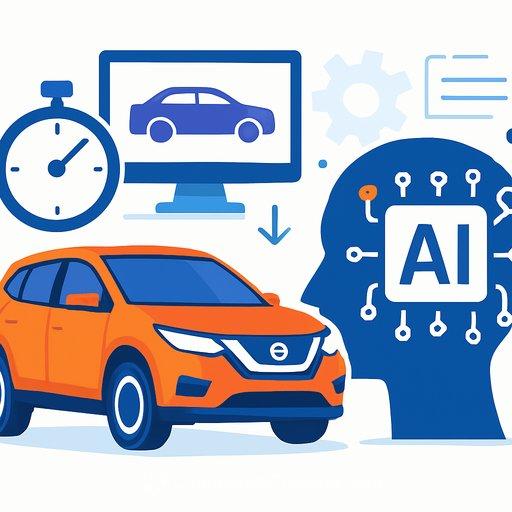
Nissan’s Bold AI Move: Slashing Car Development Time
Imagine designing a car in less than half the time it used to take. That’s exactly what Nissan is doing by embracing artificial intelligence (AI) across its vehicle development process. This innovative approach is poised to supercharge the company’s production pipeline, letting them bring new models to market faster than ever before. For tech enthusiasts and aspiring AI professionals, Nissan’s journey offers a real-world look at how AI is reshaping a traditional industry.
The Numbers: Speeding Up Innovation
Traditionally, it took Nissan about 55 months to turn a concept into a finished vehicle ready for the showroom. Now, thanks to AI-driven design and engineering tools, that timeline is being slashed to just 26 months. By the end of fiscal year 2026, Nissan plans to use this efficient workflow for 90% of its new models. That’s a massive leap in productivity—and a wake-up call for the entire automotive industry.
Where Does AI Fit Into Car Development?
AI’s impact on Nissan’s development process is far-reaching. Here’s how:
- Design Simulations: AI algorithms can rapidly generate and test countless design variations, optimizing for safety, efficiency, and style.
- Virtual Prototyping: Instead of building physical prototypes for every tweak, engineers use AI-powered simulations to spot potential issues early.
- Data-Driven Decisions: AI sifts through mountains of sensor and market data, helping teams predict performance and customer preferences before a single part is manufactured.
What This Means for Beginners in Tech
If you’re just starting out in the tech world, Nissan’s success story highlights the growing demand for AI skills—even in industries once considered slow to change. Automotive companies are now some of the biggest tech employers, seeking talent in machine learning, data analytics, and simulation engineering. Learning these skills not only opens doors in car manufacturing, but also in sectors like aerospace, healthcare, and consumer electronics.
How to Get Involved: Learning AI for Real-World Impact
Want to follow in Nissan’s footsteps? Here’s a roadmap for tech learners:
- Start with the Basics: Build a solid foundation in Python, statistics, and linear algebra. These are the building blocks of AI and machine learning.
- Explore Automotive Data Sets: Many open-source projects and competitions use car-related data. Try your hand at analyzing vehicle telemetry or simulating crash scenarios.
- Build Projects: Create simple AI models that could, for example, optimize routes, predict fuel efficiency, or even generate car designs.
- Stay Curious: Follow industry news and case studies—like Nissan’s—to see how your skills could be applied in real companies.
The Bigger Picture: AI’s Role in the Future of Work
Nissan’s AI strategy isn’t just about cars; it’s about transforming how companies operate. As more organizations adopt similar tools, the ability to collaborate with AI will become a core professional skill. Whether you’re interested in coding, engineering, or project management, understanding AI’s potential will give you a significant edge.
Practical Takeaways for Tech Learners
- AI is now a must-have skill, even in traditional industries like automotive manufacturing.
- Hands-on projects and real-world data are the best way to understand how AI drives business transformation.
- Staying adaptable and curious will help you keep pace as AI continues to reshape the workplace.